Tuesday, May 22, 2012

SARAH AND THE INCLINOMETER

By Dr. Robert E. Plucker

Circa 2000


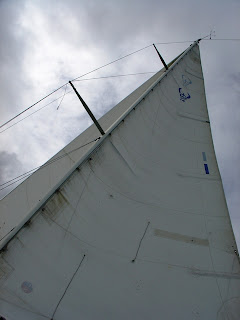
Those people who are not accustomed to sailboats are often amazed and alarmed when the boat leans over to one side.   This is heeling, and it is a part of being propelled by wind.  One explanation that I have heard is that every other kind of boat will tilt to one side when hit by a wave, and then will tend to tilt to the other side before coming to an equilibrium.  A sailboat heeled over will not do that; it will lean over away from the wind; its motion is dependent on the wind, and to a much lesser extent, on the wave action.  Sailboats larger than tiny day-sailers will have weight below the hull to counterbalance the sideways thrust of the mast and its sails.  This weight, whether a fixed keel or moveable centerboard, can be nearly half the entire weight of the boat, causing it to pop up after you have knocked it down like a child's toy.  Many sailboats are capable of righting themselves automatically even if they were entirely capsized.  The force of heeling has to become less as the boat leans further and further over, spilling the wind out of the top of the sail.


Another aspect of boat stability is the shape of the hull.  In general, a flatter bottomed hull will want to stay upright and will tend to sail poorly under extreme heeling.  A more round bottomed boat will heel more under the same strength of wind, but will sail effectively in that condition.  The Newport 30 that we enjoyed so much for sixteen years was rather flat; Greta, the Ericson 34 that we have loved so well for fourteen years is rather rounded.  I bought a cheap little inclinometer, similar to a carpenter's level to check on just how far the boat actually heeled over.  Incidentally, any boat will "list" if it is out of balance; a poorly distributed load is usually the cause.  Sailboats "heel", and their skippers tend to get upset if landlubbers keep insisting that the boat is listing. 

I enjoy taking young people out sailing, and years ago I would take my college students out on Saturday day trips.  With son John in high school, I took many of his friends out.  So on one of these expeditions with John and his high school friends I had two new-comers to sailing aboard, Sarah and Soren.  (No, they are not related to each other at all.)  Soren took to the sailboat motion with little trouble, but Sarah seemed a bit apprehensive.  She caught sight of the inclinometer, mounted right where everyone could see it.  What was that for, she wanted to know.  I told her it was to let me know how many degrees the boat was leaning over from the vertical.

We got out from the shelter of the inner harbor a bit further, and the heeling increased to about fifteen degrees.  As you get further out, in the Haines harbor, you can expect stronger winds.  We got them, and the heeling increased to perhaps twenty degrees, but varying with the small gusts of wind that one usually encounters in this mountainous country.  By the time we got to thirty degrees of heel, Sarah got nervous.  She wanted to know how far the boat would tip to one side before it would refuse to come back upright.  I explained to her approximately what you have read in the first paragraph of this essay.  Since we were now in the middle of Lynn Canal where the wind could be expected to be the strongest, I felt safe in telling her that if she wanted to get really concerned, she could start worrying at about forty degrees. 

Where there are gusts of wind, there are sometimes GUSTS.  Wouldn't you know, within seconds of having said that, one of these GUSTS came along and gave us a real “knockdown.”  I didn't take time to look at the inclinometer, but I know from experience that we heeled a good bit more than forty degrees.  We didn't have just the lee rail under water; we actually took in a few gallons over the coaming of the cockpit.  This is one of the times you listen to the screaming and rather wish you had reefed the sails a while back when you had the chance.  But even these strong gusts are only gusts, and the weighted keel did its job very well indeed, and we popped right back up to our former position.   

But Sarah must have had her eye on the inclinometer, because all four or five of us aboard could see that she was terrified.  Perhaps if I had just stuck to the explanation in the aforementioned first paragraph she would have been less scared, but no, I had to mention forty degrees. 

After this GUST, we did not experience any more, but to reduce chances of more terror, I turned downwind a bit more, slackened the main and the jib a bit, and the wind cooperated by moderating.  This experience was scary for Sarah, but not long after that she begged and pleaded to come along with me and several others to go all the way to Juneau to a Cross Country run.  Lest we forget about Soren, he was cool; I don't think I have ever seen him flustered.

Thanks to Wikipedia for this photo.

Sunday, May 20, 2012

A NEAR FATAL JIBE

By Dr. Robert E. Plucker

               Joey was in our son John's high school class, and had the reputation which he still has, of being an adventurer.  He also was, and is quite skillful working with wood.  Joey had been sailing with us quite often, and since his father owned a workboat, it seemed fore-ordained that Joey would try his hand at building a boat, a sailboat.  I don't know how much help, if any, Joey had in building the boat, but it turned out to be a beautiful work of art.  It was a small enough boat to not require a weighted keel, but the ballast of the passengers shifting their weight from side to side would keep the boat upright in conditions where sailing a boat this small is at all practicable.
               Joey came over one day to pick up John and Lee; they were to go sailing in Joey's new boat.  "Good luck", I thought to myself, as there seemed to be zero wind on Lynn Canal.  I went down to the dock to see them off.  As predicted, there was virtually no wind, and they had to row out a fair distance before catching the slightest hint of a breeze.  I got bored watching them, and walked back home.
               I noticed later in the afternoon that there was a bit of a breeze.  I did not know that the boys had come back to pick up Lucinda, also in their high school class.  That made four adult-sized people aboard, and Lee is no lightweight. There would be plenty of ballast, but the boat would be fairly low in the water.  Later in the afternoon I was out for a walk and glanced out over the water as I so often do.  I thought I might be able to glimpse the small white sails of Joey's boat.  What I saw was the Chilkat Cruises fast ferry coming back from Skagway roaring back to their Haines dock as usual, but with a major difference.  It slowed dramatically, turned around, and seemed to drift in one spot for a while.  Eventually I got tired of trying to figure out why they didn't stick to their usual rush to the dock and went home.
               In perhaps forty-five minutes or so, Lucinda, Lee, Joey and John came to our door, looking harried, bedraggled and damp, trying to act super-cool.  After all, that's what teen-agers do, they act cool.  They wanted to know if it would be OK for Joey to take a shower now, in our bathroom.  "We will explain everything later", they said.  So Joey spent some time in the shower while the other three were lined up on the couch, trying to huddle together under a blanket.  They assured us they would tell everything only after Joey got out of the shower.
               Joey had been very cold, the coldest of the four. They tried to make light of their adventure, but the further they got into the story the more I was convinced that they were alive only by the grace of God.  The wind had increased significantly, and Lucinda suggested they turn back.  Lucinda knew the wind on Lynn Canal perhaps better than the boys, as she had had a good bit of sea-time on her father's fish-boat.  Eventually even fearless Joey agreed to head back to the Haines Boat Harbor.  They had been sailing with the wind on the starboard quarter, nearly directly ahead of the wind.  They were probably deceived as to the strength of the wind as the boat speed subtracted from the actual wind velocity gives an apparent wind that seems much less than it is. Of course the wind always feels better if it is blowing on your back instead of having to face into it.
               What they attempted to do was to turn to the starboard, as the mainsail was on the port side, and they could have easily come up into the wind, tightened up the main and jib sheets, built up a little speed, and then come about through the eye of the wind and be headed straight for home.  From what I gathered from their account of it, Joey had attempted to do the whole maneuver in one step. Turn to starboard, leave the sheets slack, go through the eye of the wind, wind up on the port tack and be headed for home.  For some reason it did not work; the boat did not have momentum enough to go all that distance through the eye of the wind, finally catching the wind on the port side.  Apparently a 270 degree turn was just too much; they fell back on the original course, wind on the starboard quarter, and were sailing full speed away from shelter.
               Next they tried jibing.  This is a tricky maneuver in a strong wind, and is usually a bad idea.  It involves turning the boat in the direction of the mainsail.  That is, if the sail is spread out on the left, turn to the left. Eventually the wind will catch the back side of the sail and will blow sail and boom across to the other side at great speed and with devastating effect if some person happens to be standing in the way.  There are ways to limit this danger, but Joey and company were not experienced enough to know much about them.  When Joey's boat was broadside to the wind, evidently two bad things happened: the main sheet did not freely run out as it should have, and the ballast/passengers were too slow about shifting their weight to the windward side.  With the mainsail catching the full side force of the wind and the ballast on the wrong side, the boat had to suffer a severe knock-down, ending up with the mast and sails floating in the water, the hull floating on its side.  Being wood, the boat would not sink, and they had a fighting chance to right the boat.  
               According to their accounts, they did succeed in getting the boat upright, temporarily, but it was full of water, and they couldn't bail the water out as fast as the waves filled it.  Miraculously, they were all wearing life jackets, which is not usually the cool teen-age thing to do.  Lee, Lucinda and John managed to get out of the coldest water, somehow climbing onto the side-ways floating hull.  Joey could perhaps have done the same, but he was too engaged in trying to save his oars, and was hanging onto the mast with one hand and holding onto the oars with the other.  This seems irrational, but people do unexpected things when under extreme pressure sometimes.  This was why he was so much colder than the others, probably he was close to serious hypothermia. It should be noted that in the cold waters of the Lynn Canal, the average survival time has been estimated at ten to twenty minutes.
               So there they were, adrift in a very precarious position, but still not aware they could all be dead in a very short time.  It may have been Lee who pointed out with confidence that the Chilkat Cruise’s last ferry trip of the day would be due soon, and they would be rescued.  Sure enough, here came the fast ferry, hell-bent-for-election as usual.  Captain Molly and the crew saw neither the capsized sailboat nor the three miserable creatures perched on the side.  Joey and the sail in the water would have been virtually invisible.  By great good fortune, or by the guidance of a guardian angel, one of the ferry passengers happened to see them, rushed to Captain Molly and the rescue operation was started.  If I had had my binoculars with me on that walk, I could have watched the whole procedure.  Remember, I had wondered why the ferry had turned around and stopped.
               John was not impressed by the rescue operation.  He said the crew kept throwing things at them in the water.  Life jackets, which they already were wearing, and other flotation devices which they didn't need at that point.  Finally, after a lot of yelling John said he got them to throw just a plain old line, which he caught and hauled himself aboard.  He was a little ashamed to be the first to be rescued, but with the line in his hand it made more sense to use it, and then help to get the rest aboard, especially Joey who must have been in real trouble by this time.
               So they arrived at the Chilkat Cruises dock where some kind soul gave them a ride to the Senior Village apartment where we were living at that time.  Joey's boat was left drifting in the water, sails still set, but floating waterlogged in their horizontal state.  A fish-boat was dispatched to tow it in, but where the oars were at that point I do not know.  They were eventually saved by someone.
               Since the kids were so cool-acting when they first got to our home, I think I did not appreciate the gravity of what had happened until much later. Lucinda's mother was angry over the whole episode, I was sorry I had ever let them leave the dock (in a dead calm), and Margaret was upset later because of strong language John had used when being interviewed for a story in the Chilkat Valley News.  On the radio interview which was broadcast not only over KHNS, but the Alaska Public Radio, John did comment, "I am now a believer in wearing life jackets!"
 
 
Circa 2000/2001

Tuesday, May 15, 2012

MARINE-TYPE DEFINITIONS

By Dr. Robert E. Plucker

(These are mostly original, but some are well-known.)


Bikini              A tiny Pacific Island, also a tiny article of clothing never seen on the foredeck of a sailboat north of Lat. 48 N.

Boat                A vessel small enough to be carried aboard a ship (see ship).

Chimney        Also has the archaic name of Charley Noble, a vertical pipe leading from a heating device located forward in the cabin of a live-aboard sailboat, which inevitably fouls the sheets when coming about.

Come about   A sudden scary turning maneuver that results in wildly flapping sails, yelling, yanking on ropes (oops, sheets) finishing with all the passengers sitting on the wrong, or low side.

Compass       A crude, low-tech instrument that will indicate the general direction of North, but never true north, and only if there is no metal near it, and it must have been properly swung, adjusted, compensated, and the incantation about True Virgins Make Dull Companions has been recited.

Depth Sounder          A gadget that explains to the skipper that the reason his boat is no longer moving is because the water is too shallow to float the boat.

ETA               A question asked late in the trip by uneasy passengers who belatedly mention to the skipper that they have an appointment ashore (or wish they had) in fifteen minutes.                                                    


Fisherman        Someone who can't understand why sailboats exist.

GPS             A nearly miraculous method of electronic navigation that will let your boat run over a gill-net while you are watching the tiny screen for the next way-point, speed, direction, compass heading, etc.
GPS 2             Same miraculous gadget that will set your course as the shortest possible distance to the next way-point, quite probably over very shallow water, rocks and other dangers the skipper would see if he stopped watching the GPS screen.

Heel                 A tilt to one side.  This is good because it means the sails are filling properly and you have enough wind to move the boat instead of just drifting.

Jibe                 A noisy, scary turning maneuver with the wind at your back, involving the main boom unexpectedly swooping across the cockpit, coming to a sudden stop on the opposite side with a loud BANG, leaving all those who failed to duck, unconscious.

Liar                Anyone who claims never to have gone aground.

Liar 2           Anyone who claims to have never experienced the slightest sign of sea-sickness.

List                  A bad tilt to one side resulting from bad load distribution.  It can also mean your vessel is sinking.

Marine head   A complicated floor fixture meant to carry off human bodily wastes.  Skipper's nightmare when stuff inserted in head fails to go through the too small hoses.

Miracle         Somehow freeing the propeller from a line or net fouled on it without having  to go overboard and cut it off.

Rules of the Road    A hopelessly complicated system of preventing collisions and other accidents at sea which will explain to you why you do NOT have the right of way all the time, even though your vessel is a sailboat.


Ship                 Any vessel large enough to carry a boat on board.  (See boat)


Friday, May 11, 2012

A NIGHT OF MISERY


by Dr. Robert E. Plucker


We had not lived aboard the boat at LaConner very long before I got the notion to try going up the Inside Passage.  I had thought about it before, but now with the new boat and quite a lot more experience sailing behind us, I thought that I could persuade Margaret that we should at least try to spend a summer, or part of a summer in Southeast Alaska.  That was all I wanted, I thought, just one trip up the Passage; and then we could come back and live happily ever afterward at the dock in LaConner.  I never expected that Alaska would get such a strong grip on us.

We got under way one May morning, Margaret, John and I, in near-perfect weather, motoring up narrow Swinomish Channel to Anacortes and beyond.  Far beyond.  John, at nine years of age, was totally "into" sailboat travel.  The trip was eventful, and fun, but we decided to stop at Petersburg.  This is well inside the Southeast panhandle, and gave us the experience of navigating Wrangell Narrows.  Somehow, before reaching Petersburg, we found that the Alaska Marine Highway system was offering a very generous special rate to seniors that year, only five dollars going northerly as far as Skagway and another five to return.  John was still young enough for half-fare, so Margaret was the only "adult" among us.  She would have to pay the full fare. But what a bargain, and how could we not take advantage of it!  To Skagway and back!

[www.ci.petersburg.ak.us/]
Margaret was full of enthusiasm for the project; she made a number of phone calls, finding out that the ferry had already left from Petersburg, but that we could catch it at the village of Kake. There was a special flight of a LAB plane leaving for there in about three hours, so we would have to hurry to catch it.  I did not think there would be much frenzy about catching the plane, but it turned out that we needed food (Margaret always has food on hand when she goes nearly anywhere), extra clothes, books, toys, toothbrushes, "stuff", all sorts of things.  But we got it all done and caught the plane, a single-engine DeHavilland Beaver.  Our boat, "Greta", was locked up, and safely tied up at the visitor's dock in Petersburg.

The Alaska Marine Highway ferry "LeConte" was to be at the ferry dock in Kake early in the morning, and so we would have to spend the night there.  Of course we thought there surely would be at least one motel or B&B that could put us up for the night on short notice.  The LAB people were incredibly kind to us, driving us to a few places they thought might have a room for us.  But no, Kake is a very small Native village, and they were not set up to take in very many people; it turned out there were a few lumber-people there already, and had already taken the few rooms available in private homes.  The only choice then, was to stay at the ferry terminal, sleeping on the floor, no real problem.
So, off to the dock, where reality set in.  The "ferry terminal building" was a kind of picnic shelter, completely open to the mosquitoes, "no-see-ums," and the cold.  We huddled there for a short while, perhaps thirty minutes, until a local man took pity on us.  He had a Pepsi van that was to be taken back to Sitka on the same ferry we were waiting for, and we could sleep in the van. Sleeping in that van was one of the horrifyingly bad experiences of my sixty-five years of life.  No seats, except for the driver's perch; the rest was corrugated steel floor.  There were some flattened paper cartons spread on the floor which was supposed to keep out some of the cold and straighten out the corrugations of the floor, but there seemed to be no effect.  No comfort to my frozen old bones, but at least we were out of the range of the mosquitoes and other bugs.  But yes, it can get COLD in early June in Southeast Alaska.

Kids somehow seem to have the ability to withstand cold.  Think of the number of mothers the world over, who have to compel their youngsters to put on a coat when going out into the cold.  John was not bothered by the cold, and for some reason; Margaret didn't seem to be badly chilled either.  That rascally John spent a good part of the early evening laughing and chortling over how funny his father was, grumbling, shivering, scratching, and complaining.  All this discomfort was magnified by us having overheard a conversation earlier that expressed some doubt as to whether the ferry would be very late, or if it would stop at all.

When morning came, at about 5:30, LeConte came into view, tied up at the dock, and allowed us to come aboard perhaps by 6 o’clock.  LeConte is one of the smallest and least luxurious of the ferry fleet, but to me it looked like the Queen Mary.  And after all, who needs luxury, when you can get warmth.  The two luxuries aboard were the hot showers and the 24-hour hot coffee, free during the night hours.  There were probably fewer than two dozen passengers on the northward leg of the trip, and not many more on the return. 

LeConte could just as well have been our private yacht.  There are no cabins on that ship, so one sleeps on the floor, or in a chair, or on a sort of plastic cot in the solarium on the upper after-deck.  To me it was all super deluxe accommodation.  If you have spent a cold, cold night on the corrugated steel floor of a Pepsi van, you appreciate sleeping on a warm carpeted floor, as we did.

The rest of the trip was good, Sitka was great, there's a fine bookstore/coffee shop near the Russian Orthodox Cathedral, the villages of Angoon, Hoonah and Tenakee were all quick stops, the ferry terminals at Juneau and Haines were so far from downtown that we never left the ship.  The big turnaround is at Skagway, the end of the Inside Passage.  All the huge Cruise Ships stop there, making Skagway a candidate for America's largest retail center for T-shirts and cheap jewelry.   John and I had an ice cream cone, but were glad to escape the crowds of tourists and re-board the ship.

So returning to our beloved "Greta" in Petersburg and finally back to LaConner, our "summer in Alaska" came to an end.  I still had no idea that we would make three more trips up the Passage in Greta, and finally on the fourth trip, back to stay.


The LeConte 
[www.dot.state.ak.us/amhs]


Saturday, May 5, 2012

Women on the Sailboat


By Dr. Robert E. Plucker


     In 1970 I had my first chance to actually sail on a sailboat, under sail.  My friend in the History Department had a brother-in law who had just acquired a Columbia 22-footer, and I was invited to sail with them several times.  We three men enjoyed ourselves thoroughly.  In those days, before I had read anything about great women sailors, I assumed that women were not much interested in sailing, would be awkward, in the way, and would inhibit the behavior of the men aboard.  We would, at least back in 1970, probably have to watch our language. 

     I was so spooked by the thought of women aboard that I actually jumped ship two-thirds of the way through a three-day trip when it was decided that the wife/sister of the other two was to come aboard for the last day.  My excuse was that four people on a twenty-two foot boat would be more than enough.  But now I have come to my senses and have welcomed a number of women aboard in the intervening thirty-five years.  One disappointment of course, was that sailing on Puget Sound and to the north hardly allows for gorgeous young ladies in bikinis sunning themselves on the foredeck.

     Roxanne was one of three students of mine that I took out sailing one Saturday afternoon.  The boat that I had was a shallow draft vessel built to easily take grounding in mud or sand.  That was a good thing, as our moorage was a distance up the Snohomish River, reachable only at higher tides.  Inexperienced as I was, I was too late to get back before the water got too shallow and the boat came gently to a halt in the mud of the river-bottom.  There was nothing to do but wait for the tide to run out the rest of the way, and then back in, some six or seven hours later.  I didn't worry, nor did the other two fellows aboard, but Roxanne did.  There are few things as dependable as the tide, but Roxanne wasn't so sure.  She told me later, "I prayed and prayed as hard as I could for God to bring back the high tide so we could float free."

     OK, but I doubt that God needed the reminder.

     After the shallow-draft boat, and following a divorce from my first wife, I bought a wonderful new boat, a Newport 30.  I meant to live aboard the boat, sail every time I felt like it, and never look seriously at another woman.  Ha!  Margaret changed my notion of being a hermit very soon by accepting my invitations to go out sailing on Saturday afternoons.  One hot afternoon we had completely run out of wind at Elger Bay, which is always a kind of dead spot on the west shore of Camano Island.  We drifted along for some time, and my thoughts were racing.  My divorce had become final.  Margaret was so pretty and charming.  There was no wind.  Not much to occupy my mind except Margaret.  What to do?  Well, why not ask her to be my wife?  So she said yes, and thus began the second part of my life.

     Communication can be a problem.  This possibly is not true with all women, but my former wife, and now Margaret, many times does not make messages clear.  For example, you are sailing along at about six knots and suddenly you see waves breaking over what is probably a rock that you might not have noticed on the chart.  Wife #1 would yell "yerp!" and then probably "yerp yerp!”  Wife #2 would yell "Oh!" and "Oh!" and so on, getting louder with each "Oh".  Either yell is an alarm I suppose, but the skipper, me, would much rather have heard something more specific.  "Rock, rock!" would do the job nicely.

     After sixteen years of good sailing with "Echappee," the Newport 30, we decided to try living aboard the boat year 'round.  We sold our Camano Island house, and with the trade-in of the old boat, we bought "Greta," an Ericson 34.  This led to some fairly serious sailing, including three trips up the Inside Passage to Southeast Alaska, the result of which was the decision to make Haines, Alaska our home.


Bob, John and girl friend.
     Since living aboard, first in Washington and now in Alaska, Margaret and I don't have as many guests for sailing as we used to.  Years ago we had some interesting ones, like the woman who seemed to spend much of the trip going back and forth to the head (bathroom).  We couldn't figure out why she had to "go" so often.  The truth was revealed eventually, that she was an alcoholic and had her bottle of whatever she was drinking stashed away somewhere and only went to the head to drink.  It seemed like she needed a booster every half hour or so.  Margaret and I were too innocent and ignorant to recognize the signs that she was alcoholic.  We heard later that her husband (who was an Internal Revenue agent, and also rather secretive) got her straightened out, I suppose by going to AA.

     In the late 70s, there were a number of Arab students who came to study at my school, Skagit Valley Community College.  We invited one young man and his wife, plus another Arab friend of theirs to go sailing.  These people, if I remember correctly, were from Kuwait.  The wind was just right for good sailing that day, but it was chilly, as usual in Port Gardner Bay.  Our guests must have had a Caribbean notion of sailing, as they were definitely not dressed for warmth.  The young Arab lady was a beauty, and her "yachting" clothes made her a stand-out.  She had to stay below for the entire time, as it was too cold on deck.  Her husband could have kept her company, but he was so sea-sick that he spent almost all the time lying down with his head in her lap, not talking.  The other fellow survived the trip from Everett to Edmonds and back in better shape, but you could easily tell he was glad when he could get ashore again.  We could have turned around and shortened the trip a good deal, but we were hoping things would get better, and we had two other friends aboard and did not want to disappoint them.  These last two were having the time of their lives.

     One good friend of Margaret's refused our invitations to go sailing several times.  Her last refusal carried the excuse that she thought her children were going to be sick on the planned-for day.

     Women, but by no means only women, need strong warnings about the excessive use of toilet paper aboard a boat.  Marine toilets tend to jam rather easily when wads of paper are used.  This too often requires the exalted skipper/owner of the vessel to change hats to that of the lowly plumber of the vessel.

     After a lot of red tape and passing of Coast Guard exams, I received my Coast Guard license to take passengers for hire.  Two summers were spent taking as many customers as I could attract, on two or three hour day- sails.  It was fun, and I met some wonderful people at that time.  The Newport 30 was tied to a floating buoy in Utsalady Bay, and the passengers had to be ferried out to the boat in a dinghy.  I was dumbfounded one day when my people came to the beach, got out of their car and proceeded to help a wheel-chair bound woman out to the waiting dinghy.  I must have looked dismayed, but before I could say anything about the impossibility of getting this woman out of the dinghy and up into the cockpit of "Echappee," she told me rather forcefully not to worry about her transfer from the tiny dinghy to the 30-foot boat.

     The only good thing was that the dinghy was one of the super-stable double-hulled Livingston boats that are virtually impossible to upset.  This lady got her companion to boost her just far enough so she could reach the stern rail of "Echappee."  She grabbed it and somehow pulled herself up and over in a second or so.  Just like that, she was seated like a queen on the starboard cockpit seat.  This was one strong, gutsy woman!  Good trip!

     Daughter Holly has given me wonderful memories of those earlier sailing years.  Her territory was the forward V-berth where she held court over her thirty or forty stuffed animals.  Son John was still several years in the future.  Coming back from a week of sailing, some adult asked her if she had ever been sea-sick.  "Yes" was the answer.  Where was she at the time she was sea-sick?  "At Grandma's house."
Holly, Bob and Margaret with Holly's three boys.

     Holly also had an extensive entourage of imaginary employees to run her imaginary restaurant.  I was to be the customer most of the time and always pretended to be dreadfully finicky.  I would send back the imaginary food on all sorts of pretexts and once got her and Margaret to laughing because I sent the water back to the kitchen.  Not wet enough.

     One fine summer day Marilyn and Julia were out in Skagit Bay with Margaret and me.  They had been out with us before and had learned a bit about sail trim and how to make the boat go in different directions.  So Margaret, Julia and Marilyn were to be skippers and crew, but no one was designated to be skipper of final resort.  I stayed below and played galley slave, washing dishes after a fairly elaborate lunch.

     Probably they could have figured things out separately, but they were all too polite, constantly deferring to one another.

     "Do you think we should tighten this rope?"

     "Steering with that long stick is certainly confusing; you have to move it to the left to turn right."

     "I can't seem to fix this sail so it won't flap like that."

     "Maybe we need to come about."

     "What does 'come about' mean?"

     It was a nice day, everyone had fun including the lone male aboard – me.  But I would not want to sail in a strong wind with the skippering done by this committee.  Even if they all wore bikinis.

     And lastly, my dear wife Margaret who took charge crossing the Strait of Georgia in heavy seas.  I had fallen part way down the companionway into the cabin, crashing into the restraining bar that guards the cooking stove.  She was steering.  I had gone below to check our position on the chart and was thrown onto the steel bar by a much steeper than usual wave.  So I had a broken rib and was in great pain, not being able to speak from all the groaning.

     Margaret was horribly frightened over all this, but did not dare leave her job at the tiller.  Our son John was on board, asleep, but at eight years of age, could not be expected to handle the wheel in seas like these.  But Margaret screamed at him to wake him up to find out what was wrong with me, as I had disappeared from her line of sight.  All he could tell her was that I was on the floor and moaning.  Being assured that I was alive helped her some, and she decided to head for Porlier Pass to get to the usually calm waters in the Canadian Gulf Islands.  After a few minutes I was able to pull myself together enough to get back to the cockpit where I was not of much use but to lend moral support.
     Porlier Pass was close, but we had never before been through this narrow rock-strewn pass with its strong currents.  I might have tried to continue on to Active Pass which was much safer and familiar to us, but much further away.  But Margaret was now the skipper and she made the decisions.  So under power and the mainsail, we headed for this twisty, narrow channel, strong current against us, but with some wind behind us. 

     As we entered the narrow part of the channel, Margaret was getting all the speed out of the twenty-eight horsepower Volvo that she could, and the following wind was some help, but there were times when it seemed that Greta was at a standstill, and maybe even going backward with the current.  Frankly, I had given up on ever making it through the pass and was worrying about what would happen if we crashed backward into a rock.  But Margaret's courage and determination carried the day, perhaps aided by a puff of wind at just the right time.

     We finally got free of the strong current and once through the pass, the water was sheltered and calm.  Later, after the crisis was over, we found that we had gone through the pass at maximum current, about eight knots.  Greta's top speed is seven knots.  Margaret's courage is the only way I can account for the extra knot and a quarter that we needed to overcome the contrary current.

Photos by Matt Davis and Jean E. Straatmeyer

Wednesday, May 2, 2012

THE RESCUE


By Dr. Robert E. Plucker

Photo by Jean E. Straatmeyer
            Our boat, "Echappee II" had had a spell of engine overheating near Deception Pass, and had been towed in to Anacortes for repair. After it was fixed, I was able to talk my good friend Floyd into going along with me to sail back to our moorage in Utsalady Bay on the north end of Camano Island. It's not all that easy to find a sailing companion in January, but Floyd was my man. Not much actual sailing was done as there was little wind, we had maybe ten miles to go, and we were glad that the little 12 horse Yanmar perked along as if it had never been sick.
            From Anacortes Skyline Marina, we headed back through Deception Pass, south through the Skagit Flats, across Dugwalla Bay and on to Strawberry Point. There was snow in the air by the time we got to Dugwalla Bay. By the time we got to Strawberry Point it was snowing hard enough to form floating slush in the water. I had never seen it snow that hard before. After Strawberry Point the snow pretty much disappeared and we could see across to Utsalady Bay, our destination. We had no trouble finding our mooring buoy among the dozen or so that were there, so we tied up, busied ourselves with straightening up below, left our life jackets aboard for the next sail, and Floyd climbed over the side to get into the tippy (Greta III) dinghy to row to shore. I took a last look around and followed him into the dinghy.

            At exactly the worst possible moment, Floyd rose partly up to change his position in the boat, and at the same worst possible moment my foot came down into the dinghy getting both of us off balance. Of course we were both dumped into the 40 degree water. This is the same water that we had always heard could kill you in twenty minutes or less from hypothermia. This was not a good thing, as the mooring buoy was probably more than 100 yards from shore, and with heavy January clothing on, our chances of getting to shore alive were not good. Utsalady Beach is not in a well-inhabited area, and the chances of anyone seeing us struggling in the water were poor. The one good thing was that there is a boat-launching ramp there, and fairly often people come down to launch boats to go fishing. But of course you can't rely on somebody coming at exactly the right time to save your life from the cold, cold water. Floyd and I did the only thing we could do; hang on for dear life to the dinghy which was upside down. It had floatation chambers; Floyd and I assuredly did not.

            The obvious thing to do would have been to get back aboard Echappee, right the dinghy, bail it out, and row to shore. Echappee had no permanent swim ladder, so we had nothing to grab to pull ourselves back aboard. Somehow we seemed to be unable to reach the mooring line to pull ourselves up over the bow, and the current was bringing us always further away from the boat, but not closer to shore. What to do? We tried to right the dinghy and actually succeeded momentarily, but had neither the equipment nor the sense to try to bail out the water before attempting to climb in. I had actually gotten into the swamped right-side-up dinghy, but there was no stability and down I went for the second time.

            While we were clinging there, Floyd's wife, who had seen us starting to cross from Strawberry Point, figured it was about time for us to land, and so she drove down to the beach, and was mystified by the sight of these two guys struggling in the water, yelling now and then. It didn't dawn on her at first that the two guys were Floyd and me flailing about.

            By this time I was having serious worry about our chances of living long enough to be rescued, but it was about then that a car pulled up, towing a trailer with a boat on it. Floyd's wife, having seen to her horror, just what and who was in the water, ran over to the two guys with the fish boat and, Floyd and I presumed, got them to go out and rescue us. It seemed to take forever for them to get the boat actually in the water and the engine started. All this accomplished, they roared off, not toward us, but away from us!

            I never could figure out why they did this, but they made a wide circle, came back, hoisted us unceremoniously over the side, and dumped us into Floyd's warm car. Floyd and his wife lived only a mile or so from Utsalady Beach, and there were two showers in their house so both Floyd and I could stand under a lot of hot water without having to wait for the other. Finest shower I have ever had.

            Whenever I tell this story, I like to say that Floyd could probably have swum to shore, as he was a powerful swimmer. I could maybe have righted the dinghy again and have luck enough to make it to shore. But Floyd could not bring himself to leave me, and I wouldn't leave him, so both of us would have drowned. And maybe that is just what would have happened if it had not been for the two guys who chose that cold snowy afternoon to try to catch a fish, or pull up a crab pot, or whatever they had on their minds.

photo from: www.gillsailinggear.com
            The two most unforgivable blunders that I committed that day were to have left the life jackets on the boat instead of wearing them into the dinghy. This was unbelievably stupid, as I knew the dinghy was a tippy one, and having come that far in the snow, there was no doubt about the temperature of the water. The second blunder was in not leaving something, a short length of line would have done it, but something, dangling over the side that we could grab to haul ourselves back into Echappee II.